When it comes to managing your accounting functions, one of the most significant decisions you’ll make is whether to build an in-house accounting team or outsource the function to specialists.
On the surface, the comparison might seem straightforward, simply compare salaries against outsourcing fees. However, the true cost picture is far more complex and often surprising.
At Integra, we regularly speak with accountancy firm owners who’ve made the leap from in-house to outsourced accounting. The conversation nearly always begins with cost, but it quickly evolves to encompass quality, flexibility, technology, and peace of mind. Let’s examine the real numbers and hidden factors that should inform your decision in 2026.
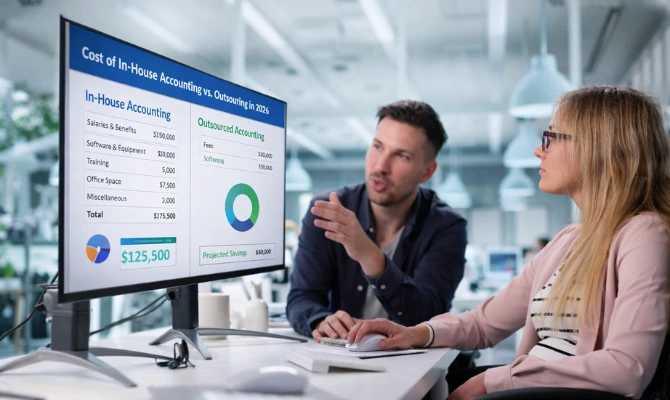
What does an in-house accountant actually cost?
The salary figure is just the tip of the iceberg. A qualified accountant in the UK typically commands a salary between £30,000 and £50,000, depending on experience and location. However, the total cost of employment extends far beyond the monthly payslip.
The hidden expenses include:
Employer National Insurance contributions add 13.8% on earnings above £9,100, plus minimum 3% workplace pension contributions, that’s an additional £5,000-£7,000 annually. Recruitment costs through agencies typically run 15-20% of first-year salary (£5,000-£10,000), and that’s assuming you get it right the first time.
Professional development and training to keep pace with changing tax legislation and accounting standards costs £1,500-£3,000 per person annually. Accounting software licences, payroll systems, and cloud storage add another £3,000-£5,000 yearly.
Don’t forget workspace costs, desk, computer, equipment, and office space all carry expenses. Then there’s holiday and sickness cover: with 28 days statutory holiday plus occasional sick days, you’re paying salary without full productivity for roughly 8-10% of the year.
When you total these elements, that £40,000 salary actually costs your business closer to £55,000-£65,000 annually. And that’s for one person with a specific skill set.
The limitations you don’t see coming
Beyond direct costs, in-house accounting teams face structural challenges. One person can’t be expert in everything, corporation tax, VAT, R&D tax credits, payroll legislation, and management accounting all require different expertise. When complex issues arise outside your team’s experience, you’ll need external consultants anyway.
Peak periods like year-end and self-assessment season can overwhelm small teams. You either accept delays, work your team to exhaustion, or hire temporary staff at premium rates.
Understanding outsourcing costs in 2026
Outsourcing firms typically charge fixed monthly fees, hourly rates, or transaction-based pricing. For small to medium-sized firms, monthly fees typically range from £500 to £3,000, depending on transaction volume and complexity.
This usually covers bookkeeping, management accounts, VAT returns, and payroll processing. Year-end accounts and corporation tax returns might cost an additional £1,500-£5,000 depending on complexity.
Quality outsourcing providers don’t just process transactions. You typically receive cloud accounting software access, regular management reports, tax planning advice, dedicated account managers, and access to specialist expertise when needed, all for predictable, scalable costs significantly lower than equivalent in-house capabilities.
What you gain through outsourcing
Access to expertise: You gain access to tax experts, payroll specialists, VAT consultants, and management accountants without employing them individually. When you need R&D tax credit advice or international tax guidance, that expertise is already available.
Scalability and flexibility: Growing quickly? Expanding internationally? Outsourced services scale up or down to match your needs without recruitment delays or redundancy costs. You pay for what you need, when you need it.
Technology and automation: Established outsourcing providers invest heavily in technology. Robotic process automation, machine learning, and AI tools that would be unaffordable individually become accessible. At Integra, we’ve integrated cutting-edge technology specifically to deliver efficiency gains that traditional models can’t match.
Business continuity: Teams work on your account with full backup and continuity planning. Holiday and sickness cover isn’t your problem, it’s built into the service.
Strategic insight: Good outsourcing partners provide strategic financial insight, identify improvement opportunities, and alert you to risks. You gain a trusted adviser, not just a number-cruncher.
When does in-house make sense?
Outsourcing isn’t always the answer. Very large organisations with complex, high-volume operations often need dedicated in-house teams. Accountancy firms with highly specialised requirements demanding deep daily involvement might find in-house resources more suitable.
However, for small to medium-sized firms, particularly those with revenues under £10 million, the numbers typically favour outsourcing significantly.
Many firms find success with hybrid models: employing a finance manager for strategic oversight whilst outsourcing transaction processing, payroll, and compliance work. This approach offers benefits of both models whilst managing costs effectively.
Making the right decision
When evaluating this decision, consider these questions:
- What’s the total cost of ownership for in-house, including all hidden costs?
- Do you need specialist expertise occasionally or constantly?
- How important is scalability as your business grows?
- What’s your risk tolerance for key person dependency?
- Could management time currently spent on finance oversight be better used elsewhere?
Document your current costs thoroughly, not just salaries, but recruitment, training, software, space, and management time. Then compare against comprehensive quotes from reputable outsourcing providers.
The Integra Difference
At Integra, we’ve deliberately built our model differently. Whilst many outsourcing firms operate on headcount basis, earning more when more people work on your account—we focus on optimal efficiency with minimal headcount.
By integrating AI automation, machine learning, and artificial intelligence, we deliver exceptional results with lean teams. Our technology handles repetitive tasks, freeing our specialists to focus on analysis, strategy, and advice that genuinely adds value to your business.
The result? You get premium expertise and cutting-edge technology at costs that typically run 30-50% below equivalent in-house capabilities.
Looking Ahead
In 2026, the question isn’t really whether outsourcing costs less, for most accounting firms, it demonstrably does. The real question is whether outsourcing delivers better results, greater flexibility, and more strategic value than in-house alternatives.
If you’re evaluating your accounting function and wondering whether there’s a better way, we’d welcome the conversation. At Integra, we offer transparent pricing, detailed cost comparisons, and honest advice about what makes sense for your specific circumstances.
Get in touch today, and let’s explore whether outsourcing could transform your accounting functions.
People Also Ask
Q1. Is it cheaper to outsource accounting or hire an accountant?
A1. For most SMEs, outsourcing is significantly cheaper. In-house accountants cost £55,000-£65,000 annually including salary, NI, pensions, recruitment, training, software, and workspace. Outsourcing typically costs £6,000-£36,000 annually whilst providing broader expertise and technology access.
Q2. What are the disadvantages of outsourcing accounting?
A2. Potential disadvantages include less immediate access to your accountant, reliance on external providers for sensitive financial data, and possible communication challenges. However, reputable firms mitigate these through dedicated account managers, robust security protocols, and responsive service models.
Q3. How much does outsourced accounting cost in the UK?
A3. UK outsourced accounting costs vary by business size and complexity. Small firms typically pay £500-£1,500 monthly (£6,000-£18,000 annually), whilst medium-sized firms might pay £1,500-£3,000 monthly. This usually includes bookkeeping, management accounts, VAT returns, and payroll.
Q4. What is the difference between in-house and outsourced accounting?
A4. In-house accounting employs staff directly to manage finances internally, providing immediate access but higher costs and limited expertise. Outsourced accounting contracts external specialists, offering broader expertise, better technology, scalability, and business continuity at lower overall cost.
Q5. Can outsourced accounting firms handle payroll and tax returns?
A5. Yes, reputable outsourcing firms provide comprehensive services including payroll processing, auto-enrolment pensions, VAT returns, corporation tax returns, and self-assessment. Many also offer management accounts, financial forecasting, and strategic tax planning as part of their service.
Disclaimer: This blog provides general information about accounting costs and outsourcing considerations. Every business has unique circumstances and requirements. For advice specific to your situation, please contact our team at Integra UK for a personalised consultation.


 020 7993 2949


